
Strategy
Strategy
Stop Pouring Water into a Leaky Bucket: A 2026 Pipeline Audit
Stop Pouring Water into a Leaky Bucket: A 2026 Pipeline Audit
In 2026, businesses are holding their purse strings tighter than ever. Buyers are more cautious, and lead times are stretching. For executives, the goal is clear: better ROI and ROO. But when your pipeline is "leaky," it is nearly impossible to see where you are losing momentum. Getting honest with your data is the only way to stop the bleed.
In 2026, businesses are holding their purse strings tighter than ever. Buyers are more cautious, and lead times are stretching. For executives, the goal is clear: better ROI and ROO. But when your pipeline is "leaky," it is nearly impossible to see where you are losing momentum. Getting honest with your data is the only way to stop the bleed.

Nataleigh Maree Elzein – Founder of Pinch Studios
30 January 2026
Back to Blog

The Leaky Bucket Dilemma
2025 left many SMEs stuck in a state of reaction. They feel the friction in their sales systems, leading to an endless cycle of course corrections, emergency meetings, and "shiny object" pivots.
Are you holding a leaky bucket?
If you doubled your marketing spend tomorrow, would your system actually convert those new leads, or would they simply vanish through the gaps? Business decline is rarely a sudden crash; instead, it is a series of subtle, frustrating leaks:
Communication slows down.
Proposals sit in "pending" for weeks.
Prospects ask "common sense" questions they should already know.
You are trapped in a loop of repetitive "clarity calls".
Something feels off when your lead-to-conversion journey feels like a drag, but it is hard to pinpoint the failure without making the system visible. This is the core of the Leaky Bucket dilemma. There is absolutely zero point in pouring more "water" or marketing spend into a bucket that simply cannot hold it.
I often tell my clients that I would rather pause their marketing entirely to fix their systems than watch them waste budget on a broken journey. If your messaging hits the mark but your leads vanish before they reach out, you have a significant gap in your systems. In the 2026 economy, you cannot afford to wait for luck to fix a structural issue.
Consideration Mountain: Where the Heavy Lifting Happens
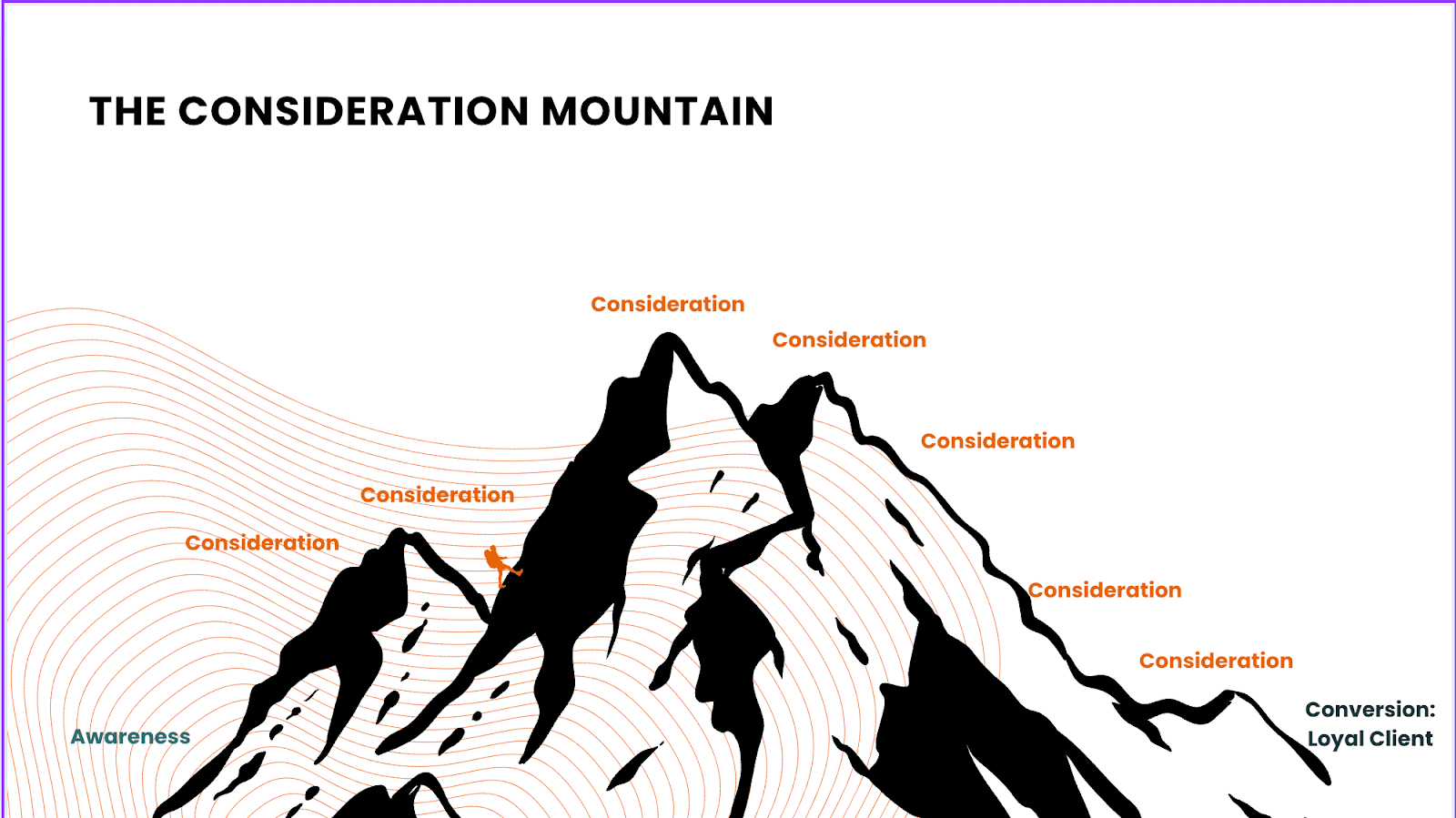
If "Awareness" is the spark, Consideration Mountain is the long, arduous climb. This phase represents the peaks and troughs between a customer first noticing you and finally making a decision. In 2026, this journey is not linear because buyers are more risk-averse than ever.
When someone invests in a service, they are weighing pros, cons, and significant risks. If you aren’t a household brand, they will deep-dive into your ecosystem to see if you practice what you preach. Most businesses mistakenly pour 90% of their effort into "Awareness" (visibility), but Top of Funnel (ToF) content is not designed to close complex deals . The leaks occur the moment after you capture attention because there is no clear path forward.
The Climber’s Toolkit: Mapping Your Assets
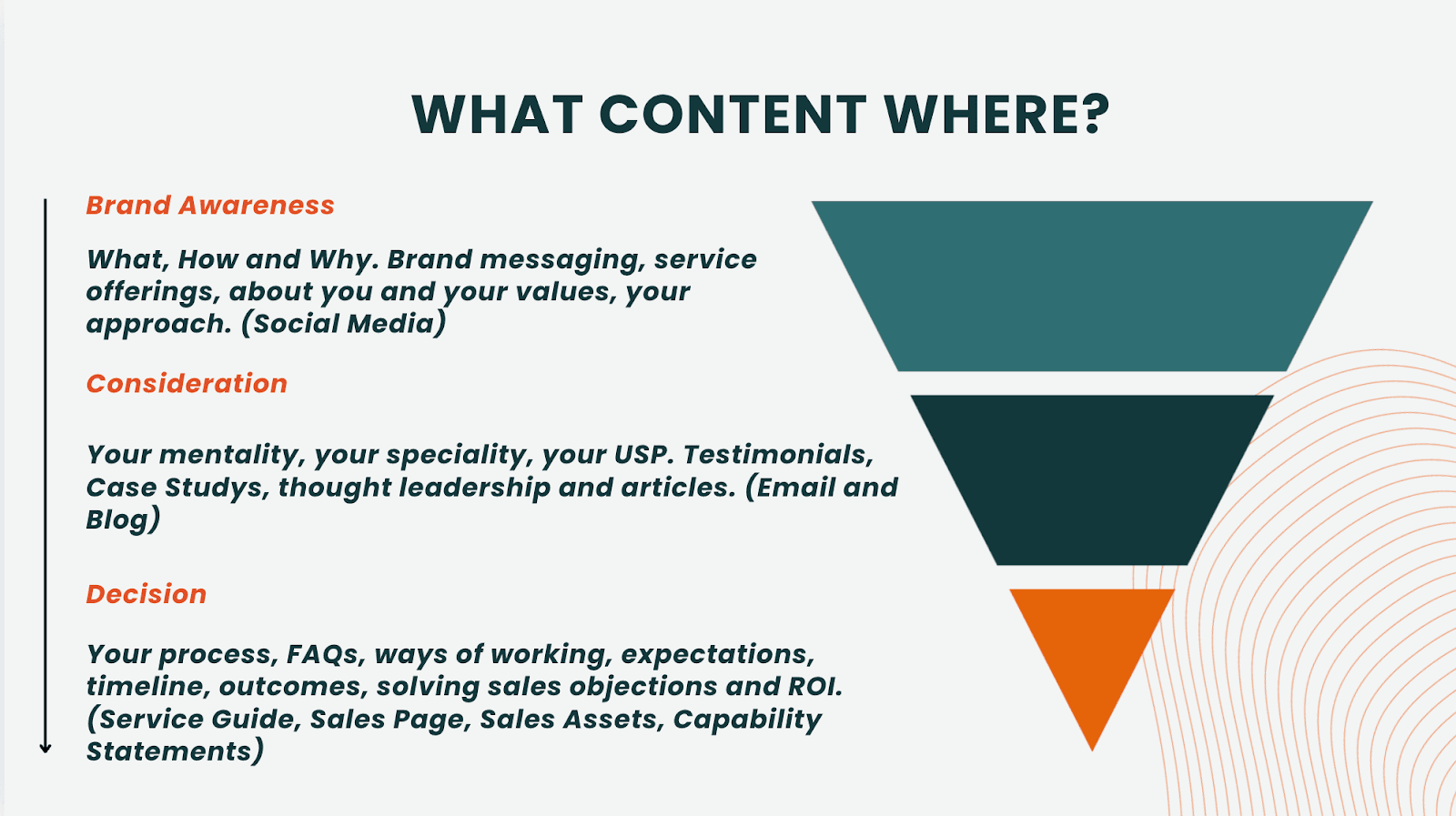
In 2026, you cannot simply "post content" and expect a predictable conversion engine. You must provide the specific "gear" your lead needs for their current altitude on Consideration Mountain. We use a framework called the Climber's Toolkit to ensure the right content reaches the right person at the right time.
The Basecamp (Awareness): This is your "Light Gear" intended for social media. Use it to provide the "scent" of your brand, including your values, approach, and the "why" behind your work. Do not try to solve deep objections here, as the audience is not yet invested enough to consume it.
The Ascent (Consideration): This is where the actual heavy lifting happens. Your leads need "Heavy Gear" like specialised data, thought leadership, and case studies that reinforce your authority. This content builds genuine demand and answers the unspoken questions that keep prospects from moving.
The Summit (Decision): These are your "Surgical Strike" assets. Deliver FAQs, ROI calculators, and detailed ways of working that solve final sales objections. This content is not for the public; it is for the person ready to plant their flag and sign.
The Credibility Fast-Track: Earned vs. Owned Awareness
We often assume the journey starts on social media, but the most effective awareness in 2026 is earned, not bought. When you guest on a podcast or speak on a stage, you are taking a "ski lift" halfway up the peak. You inherit the host’s trust, which fast-tracks the "Know-Like-Trust" cycle significantly.
However, this is also where many businesses experience their most expensive leaks. If your external authority on a global stage doesn't match your internal digital footprint, the deal dies instantly. A LinkedIn profile or website that looks stuck in 2022 creates a discrepancy that kills buyer confidence.
To stop the leak between "Earned" and "Owned" land, you must capture momentum in under three seconds:
The Discrepancy Test: Does your digital presence match the version of "you" that just spoke on stage?
The Identity Match: Does your guest appearance persona match your brand voice on your homepage?
The "Rented Land" Audit: Are you moving the audience from the host's platform to your own email list or resource hub?
The Friction Check: Stop asking listeners to "Google you". Use targeted QR codes that lead directly to "Heavy Gear" resources rather than a generic homepage.
Strategic Content Logic: Serving the Right Assets
The Climber's Toolkit helps us stop "misplacing" our efforts across different platforms. One of the biggest leaks in a pipeline is trying to solve deep sales objections on organic social media. Data shows that sharing long-form blogs on social feeds rarely yields high engagement because the audience isn't ready.
Blogs serve two vital purposes in 2026: On-page SEO and as a "Closing" tool. They act as an acquisition point for people searching for specific solutions via Google. However, their highest ROI comes when used as a "surgical strike" sent directly to a lead in a DM or email.
If you put your best assets in the wrong place, they will go completely unnoticed by the people who need them most. Your heavy lifting and FAQ killers belong in the consideration phase, where they act as a guide for the climber. Stop wasting your authority-building deep-dives on fleeting, low-engagement social posts.
The Practical: Auditing Your Pipeline
Analysing your pipeline requires a clinical willingness to come eye-to-eye with the "devil in the details". If you aren't naturally inclined toward data, delegate this to a staff member or consultant who lives for finding faults. Their "finds" are ultimately your "fixes" for the next quarter.
Phase 1: Map the Entry Points
Trace every possible way a lead becomes aware of you, from podcast appearances to SEO searches. Is the path straightforward or convoluted, and are there too many competing Calls to Action?. Identify where the friction is—perhaps a form is filled, but the manual follow-up takes 48 hours instead of two minutes.
Phase 2: Identify the "Abandoned Carts"
If a lead clicks your booking link but doesn't follow through, they have simply lost their footing. Use a three-level hierarchy to bring them back into the fold:
Level 1: The Automated Welcome (0–2 Minutes): Ensure your initial follow-up is an automated sequence that maintains interest.
Level 3: The Value Nudge (Day 3–7): Send a "Heavy" asset like a case study that addresses the specific problem they were viewing.
Level 3: The Personal CRM Strike (Day 14+): Use their personal CRM data to see what content originally "pulled the trigger" and send a personalised resource.
Diagnosis: Is it a Messaging or a Systems Problem?
Before you spend another dollar on marketing, you must understand which camp your business falls under. The following table helps you diagnose the specific leak in your bucket:
Pipeline Symptom | The 2026 Diagnosis | The Clinical Cure |
Influx of "tyre kickers" or non-ideal prospects. | Messaging Problem: You are attracting the wrong people or failing to educate on value. | Conduct Voice of Customer (VoC) research. Use your favourite clients' exact language in your headlines. |
"Crickets"—momentum stalls after the first touch. | Systems Problem: There is a "cliff edge" after awareness with no bridge to the next step. | Audit touchpoints. Simplify the decision process and automate nurturing sequences. |
Discovery calls feel like "Starting from Zero". | Consideration Leak: Marketing isn't doing the heavy lifting. | Move "Heavy" FAQ and Brand Value data earlier in the climber's journey. |
Proactive Nurturing: The Rule of Value
Following up can feel daunting, but remember: these leads initiated contact for a reason. In 2026, the "check-in" email is dead; instead, every interaction must leave the prospect closer to a conversion than when they started. Never reach out empty-handed.
Every nudge should be a piece of gear from your toolkit, such as a relevant article or a new resource for a specific pain point. Implement a Weekly Pulse Check every Friday to look at your pipeline and identify leads that have been stuck for over two weeks. Focus your best assets on the one or two leads that will bring you to your quarterly target.
The Sales and Marketing Tango
We have to stop treating Sales and Marketing as two separate rooms. In a high-performing pipeline, they perform a "Tango" with two distinct roles moving in perfect sync. Marketing’s job is to create the narrative, but Sales data is the compass that informs those efforts.
The Surgical Strike Protocol
In 2026, the feedback loop is a weapon. Sales should report back on the real-world friction and objections they hear.
The Sales Mandate: Report the exact phrases and objections "tyre kickers" use.
The Marketing Response: Instead of a generic blog, create a "Surgical Strike" asset—a specific resource designed to kill that objection.
The Result: Your discovery calls stop being "explanation calls" and become "fit confirmation calls".
The ultimate goal of this Tango is the "No Surprises" rule. By the time a prospect reaches a call, the marketing should have already done the heavy lifting. A sales call shouldn't be about explaining what you do; it should be about confirming you are the right fit to do it. When you jump on that call, use their personal CRM data to see what content piece pulled the trigger, allowing you to target your messaging precisely.
Insights Over Content: The Secret Sauce
Stop creating content for content’s sake; we are simplifying to become more effective. We don’t need more volume; we need more insight. Voice-of-Customer research is the secret sauce that makes your content sing.
When you use the exact language your customers use to describe their pain, they feel heard and seen. If your marketing feels flat, go back to your sales notes. Find the exact phrase a client used when they finally "got it," put that phrase in your next headline, and continue to finesse your messaging as you have more conversations.
The Leaky Bucket Dilemma
2025 left many SMEs stuck in a state of reaction. They feel the friction in their sales systems, leading to an endless cycle of course corrections, emergency meetings, and "shiny object" pivots.
Are you holding a leaky bucket?
If you doubled your marketing spend tomorrow, would your system actually convert those new leads, or would they simply vanish through the gaps? Business decline is rarely a sudden crash; instead, it is a series of subtle, frustrating leaks:
Communication slows down.
Proposals sit in "pending" for weeks.
Prospects ask "common sense" questions they should already know.
You are trapped in a loop of repetitive "clarity calls".
Something feels off when your lead-to-conversion journey feels like a drag, but it is hard to pinpoint the failure without making the system visible. This is the core of the Leaky Bucket dilemma. There is absolutely zero point in pouring more "water" or marketing spend into a bucket that simply cannot hold it.
I often tell my clients that I would rather pause their marketing entirely to fix their systems than watch them waste budget on a broken journey. If your messaging hits the mark but your leads vanish before they reach out, you have a significant gap in your systems. In the 2026 economy, you cannot afford to wait for luck to fix a structural issue.
Consideration Mountain: Where the Heavy Lifting Happens
If "Awareness" is the spark, Consideration Mountain is the long, arduous climb. This phase represents the peaks and troughs between a customer first noticing you and finally making a decision. In 2026, this journey is not linear because buyers are more risk-averse than ever.
When someone invests in a service, they are weighing pros, cons, and significant risks. If you aren’t a household brand, they will deep-dive into your ecosystem to see if you practice what you preach. Most businesses mistakenly pour 90% of their effort into "Awareness" (visibility), but Top of Funnel (ToF) content is not designed to close complex deals . The leaks occur the moment after you capture attention because there is no clear path forward.
The Climber’s Toolkit: Mapping Your Assets
In 2026, you cannot simply "post content" and expect a predictable conversion engine. You must provide the specific "gear" your lead needs for their current altitude on Consideration Mountain. We use a framework called the Climber's Toolkit to ensure the right content reaches the right person at the right time.
The Basecamp (Awareness): This is your "Light Gear" intended for social media. Use it to provide the "scent" of your brand, including your values, approach, and the "why" behind your work. Do not try to solve deep objections here, as the audience is not yet invested enough to consume it.
The Ascent (Consideration): This is where the actual heavy lifting happens. Your leads need "Heavy Gear" like specialised data, thought leadership, and case studies that reinforce your authority. This content builds genuine demand and answers the unspoken questions that keep prospects from moving.
The Summit (Decision): These are your "Surgical Strike" assets. Deliver FAQs, ROI calculators, and detailed ways of working that solve final sales objections. This content is not for the public; it is for the person ready to plant their flag and sign.
The Credibility Fast-Track: Earned vs. Owned Awareness
We often assume the journey starts on social media, but the most effective awareness in 2026 is earned, not bought. When you guest on a podcast or speak on a stage, you are taking a "ski lift" halfway up the peak. You inherit the host’s trust, which fast-tracks the "Know-Like-Trust" cycle significantly.
However, this is also where many businesses experience their most expensive leaks. If your external authority on a global stage doesn't match your internal digital footprint, the deal dies instantly. A LinkedIn profile or website that looks stuck in 2022 creates a discrepancy that kills buyer confidence.
To stop the leak between "Earned" and "Owned" land, you must capture momentum in under three seconds:
The Discrepancy Test: Does your digital presence match the version of "you" that just spoke on stage?
The Identity Match: Does your guest appearance persona match your brand voice on your homepage?
The "Rented Land" Audit: Are you moving the audience from the host's platform to your own email list or resource hub?
The Friction Check: Stop asking listeners to "Google you". Use targeted QR codes that lead directly to "Heavy Gear" resources rather than a generic homepage.
Strategic Content Logic: Serving the Right Assets
The Climber's Toolkit helps us stop "misplacing" our efforts across different platforms. One of the biggest leaks in a pipeline is trying to solve deep sales objections on organic social media. Data shows that sharing long-form blogs on social feeds rarely yields high engagement because the audience isn't ready.
Blogs serve two vital purposes in 2026: On-page SEO and as a "Closing" tool. They act as an acquisition point for people searching for specific solutions via Google. However, their highest ROI comes when used as a "surgical strike" sent directly to a lead in a DM or email.
If you put your best assets in the wrong place, they will go completely unnoticed by the people who need them most. Your heavy lifting and FAQ killers belong in the consideration phase, where they act as a guide for the climber. Stop wasting your authority-building deep-dives on fleeting, low-engagement social posts.
The Practical: Auditing Your Pipeline
Analysing your pipeline requires a clinical willingness to come eye-to-eye with the "devil in the details". If you aren't naturally inclined toward data, delegate this to a staff member or consultant who lives for finding faults. Their "finds" are ultimately your "fixes" for the next quarter.
Phase 1: Map the Entry Points
Trace every possible way a lead becomes aware of you, from podcast appearances to SEO searches. Is the path straightforward or convoluted, and are there too many competing Calls to Action?. Identify where the friction is—perhaps a form is filled, but the manual follow-up takes 48 hours instead of two minutes.
Phase 2: Identify the "Abandoned Carts"
If a lead clicks your booking link but doesn't follow through, they have simply lost their footing. Use a three-level hierarchy to bring them back into the fold:
Level 1: The Automated Welcome (0–2 Minutes): Ensure your initial follow-up is an automated sequence that maintains interest.
Level 3: The Value Nudge (Day 3–7): Send a "Heavy" asset like a case study that addresses the specific problem they were viewing.
Level 3: The Personal CRM Strike (Day 14+): Use their personal CRM data to see what content originally "pulled the trigger" and send a personalised resource.
Diagnosis: Is it a Messaging or a Systems Problem?
Before you spend another dollar on marketing, you must understand which camp your business falls under. The following table helps you diagnose the specific leak in your bucket:
Pipeline Symptom | The 2026 Diagnosis | The Clinical Cure |
Influx of "tyre kickers" or non-ideal prospects. | Messaging Problem: You are attracting the wrong people or failing to educate on value. | Conduct Voice of Customer (VoC) research. Use your favourite clients' exact language in your headlines. |
"Crickets"—momentum stalls after the first touch. | Systems Problem: There is a "cliff edge" after awareness with no bridge to the next step. | Audit touchpoints. Simplify the decision process and automate nurturing sequences. |
Discovery calls feel like "Starting from Zero". | Consideration Leak: Marketing isn't doing the heavy lifting. | Move "Heavy" FAQ and Brand Value data earlier in the climber's journey. |
Proactive Nurturing: The Rule of Value
Following up can feel daunting, but remember: these leads initiated contact for a reason. In 2026, the "check-in" email is dead; instead, every interaction must leave the prospect closer to a conversion than when they started. Never reach out empty-handed.
Every nudge should be a piece of gear from your toolkit, such as a relevant article or a new resource for a specific pain point. Implement a Weekly Pulse Check every Friday to look at your pipeline and identify leads that have been stuck for over two weeks. Focus your best assets on the one or two leads that will bring you to your quarterly target.
The Sales and Marketing Tango
We have to stop treating Sales and Marketing as two separate rooms. In a high-performing pipeline, they perform a "Tango" with two distinct roles moving in perfect sync. Marketing’s job is to create the narrative, but Sales data is the compass that informs those efforts.
The Surgical Strike Protocol
In 2026, the feedback loop is a weapon. Sales should report back on the real-world friction and objections they hear.
The Sales Mandate: Report the exact phrases and objections "tyre kickers" use.
The Marketing Response: Instead of a generic blog, create a "Surgical Strike" asset—a specific resource designed to kill that objection.
The Result: Your discovery calls stop being "explanation calls" and become "fit confirmation calls".
The ultimate goal of this Tango is the "No Surprises" rule. By the time a prospect reaches a call, the marketing should have already done the heavy lifting. A sales call shouldn't be about explaining what you do; it should be about confirming you are the right fit to do it. When you jump on that call, use their personal CRM data to see what content piece pulled the trigger, allowing you to target your messaging precisely.
Insights Over Content: The Secret Sauce
Stop creating content for content’s sake; we are simplifying to become more effective. We don’t need more volume; we need more insight. Voice-of-Customer research is the secret sauce that makes your content sing.
When you use the exact language your customers use to describe their pain, they feel heard and seen. If your marketing feels flat, go back to your sales notes. Find the exact phrase a client used when they finally "got it," put that phrase in your next headline, and continue to finesse your messaging as you have more conversations.
Ready to Seal the Leaks in Your Pipeline?
Book a strategy session with Carbon Edge to explore how we can connect you with the right expertise—from Pinch Studio's lead to conversion growth strategies to our full suite of digital services
More from the blog
More from the blog
All the latest news, updates, resources and more from Carbon Edge
All the latest news, updates, resources and more from Carbon Edge
Stop Pouring Water into a Leaky Bucket: A 2026 Pipeline Audit
In 2026, businesses are holding their purse strings tighter than ever. Buyers are more cautious, and lead times are stretching. For executives, the goal is clear: better ROI and ROO. But when your pipeline is "leaky," it is nearly impossible to see where you are losing momentum. Getting honest with your data is the only way to stop the bleed.
Nataleigh Maree Elzein – Founder of Pinch Studios
30 Jan 2026
Strategy

How to Strategise your Product and Brand Marketing
Are you selling features or selling feelings? The answer isn't as simple as choosing one over the other.

Marcel McCarthy - Founder of OneToo
19 Nov 2025
Strategy
Contact us
Ready to Make Tech Work for You?
Be prepared for a seamless experience from start to finish. Let's find out whether we are a good fit.
Let's start your next Project!
Suite 28, Waterman Workspaces, Level 1, M-City Shopping Centre,
2107 Dandenong Road Clayton VIC 3168

End-to-end digital solutions
for business.
Made in Australia.
Join our newsletter
© 2025 Carbon Edge. All rights reserved.
Contact us
Ready to Make Tech Work for You?
Be prepared for a seamless experience from start to finish. Let's find out whether we are a good fit.
Let's start your next Project!
Suite 28, Waterman Workspaces, Level 1, M-City Shopping Centre,
2107 Dandenong Road Clayton VIC 3168
End-to-end innovative digital solutions for business and government. Made in Australia.
Join our newsletter
© 2025 Carbon Edge. All rights reserved.
Contact us
Ready to Make Tech Work for You?
Be prepared for a seamless experience from start to finish. Let's find out whether we are a good fit.
Let's start your next Project!
Suite 28, Waterman Workspaces, Level 1, M-City Shopping Centre,
2107 Dandenong Road Clayton VIC 3168
End-to-end digital solutions
for business.
Made in Australia.
Join our newsletter
© 2025 Carbon Edge. All rights reserved.
Contact us
Ready to Make Tech Work for You?
Be prepared for a seamless experience from start to finish. Let's find out whether we are a good fit.
Let's start your next Project!
Suite 28, Waterman Workspaces, Level 1, M-City Shopping Centre,
2107 Dandenong Road Clayton VIC 3168
End-to-end innovative digital solutions for business and government. Made in Australia.
Join our newsletter
© 2025 Carbon Edge. All rights reserved.